



What’s In A Drink? University of Michigan Research Opportunity

What’s in a drink?
Alcohol and drinking culture have become prominent features in daily life. Despite being widespread, the accurate depiction of a healthy relationship with alcohol can be warped and distorted. Some of this stems from a lack of understanding of the facts surrounding alcohol consumption. Researchers and medical treatment providers have developed definitions of different types of drinking behavior. Some people find it helpful to learn more about these definitions to be able to identify drinking patterns that can or have
become problematic.
Alcohol misuse encompasses both binge drinking and heavy drinking. According to the National Institute on Alcohol Abuse and Alcoholism (NIAAA), binge drinking is defined as a pattern of drinking alcohol that brings blood alcohol concentration (BAC) to 0.08%—or 0.08 grams of alcohol per deciliter—or more. This typically happens if a woman has four or more drinks, or a man has five or more drinks, within about two hours. Heavy drinking on the other hand, includes binge drinking and has been defined for women as 4 or more drinks on any day or 8 or more per week, and for men as 5 or more drinks on any day or 15 or more per week. The more drinks on any day and the more alcohol misuse over time, the
greater the risk of harmful consequences, including alcohol use disorder (AUD).
AUD is characterized by an impaired ability to stop or control alcohol use despite adverse social, occupational, or health consequences. It is a spectrum disorder and can be mild, moderate, or severe and encompasses the conditions that some people refer to as “alcohol abuse,” “alcohol dependence,” or the colloquial term “alcoholism.” Signs of AUD may also include drinking to alleviate negative emotions, such as feeling “low,” anxious, uneasy, unhappy, unwell, dissatisfied with life, or other negative emotions that were caused or worsened by alcohol misuse.
Beyond definitions and diagnoses, many people find it helpful to reflect on their own drinking habits. For this, it is important to consider factors that may increase your risk of complications or intensify alcohol’s effects. These include taking certain medications, having preexisting health conditions, planning to drive or operate machinery, or being pregnant. Even if these don’t apply, other circumstances—like a family history of alcohol-related issues, past alcohol-related injuries, or your age—can still be relevant when evaluating your relationship with alcohol.
When drinking, it’s important to track how much you’re consuming, how long you’ve been drinking, and how frequently you drink in a given time period. Estimating your intake can be tricky, especially when you’re not preparing the drinks yourself. That’s why it helps to understand what constitutes a “standard” drink and consider the alcohol “proof”, which refers to a measure of the alcohol content in a beverage, specifically double the percentage of alcohol by volume (ABV). In the U.S., a standard drink contains about 14 grams (or 0.6 fluid ounces) of pure ethanol. This amount is typically found in:
- 12 ounces of regular beer (5% ABV),
- 5 ounces of table wine (12% ABV), or
- 1.5 ounces of distilled spirits (40% ABV, or 80 proof).
Because actual alcohol content and serving sizes vary widely—both across and within beverage types—people often underestimate how much they’ve had. As a general rule, less is better, and there are tools like drink size and cocktail calculators that can help you stay informed.
Ultimately, taking a moment to reflect on your relationship with alcohol can offer valuable insight and potentially support positive changes for your health. That’s why, at the University of Michigan, we’re launching Web-Based Diaries of Psychiatric Symptoms – Drinking (DoPS-DR, HUM00273558), a research project inviting voluntary participants to track their thoughts and behaviors related to alcohol over a 30-day period using a web-based application. The goal of this study is not to change your current habits, but to gain a better understanding of alcohol use that can inform future research.
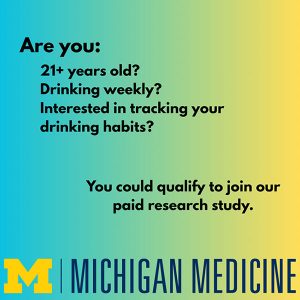
Eligible participants will complete an informed consent process and a brief screening/baseline assessment before beginning the 30-day reporting period. If you’re interested in participating or would like to learn more, please reach out at BPResearch@med.umich.edu or by phone at (877) 864-3637. We’d be happy to
answer your questions.




1 Comment
Good day,
Are you able to refer me somewhere in South Africa, particularly around Johannesburg?
Thanks